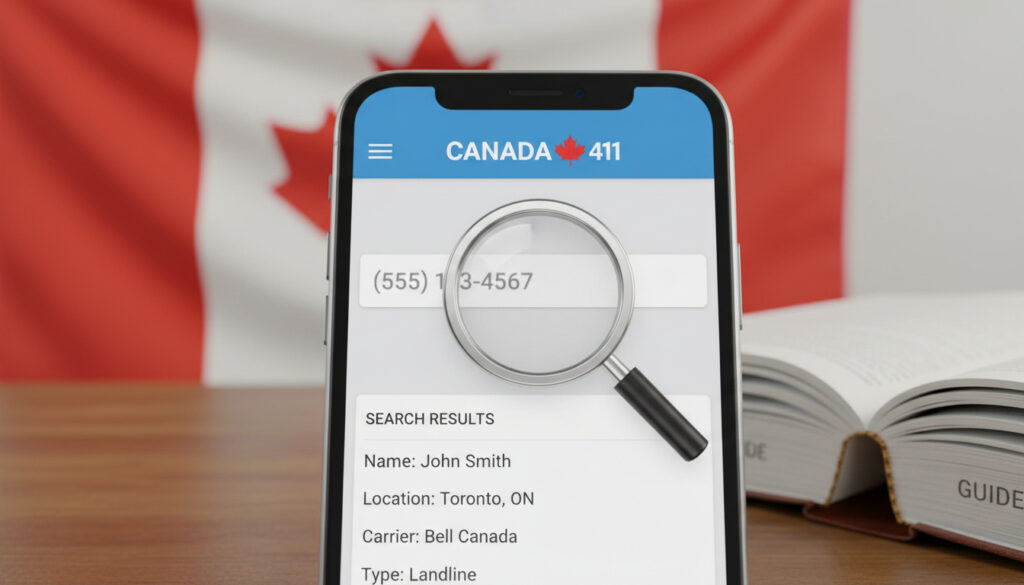
Canada 411 Reverse Lookup – Free Guide Steps and Tips
Canada411 operates as a free digital directory service allowing Canadians to identify unknown callers through reverse phone number searches. The platform functions as an online equivalent to traditional white and yellow pages, aggregating publicly listed residential and business landline information while operating within strict federal privacy frameworks.
The service primarily serves individuals seeking to verify unidentified numbers or locate contact details for legitimate purposes. Unlike comprehensive investigative databases, Canada411 restricts its scope to voluntarily submitted or publicly available directory listings, excluding unlisted numbers and most cellular lines due to protections under the Personal Information Protection and Electronic Documents Act (PIPEDA) and Canadian Radio-television and Telecommunications Commission (CRTC) regulations.
Users access the tool through standard web browsers without subscription requirements, though the platform offers supplementary mobile applications for on-the-go searches. The database draws from telecommunications carrier listings and user submissions, creating a searchable index that balances public accessibility with individual privacy rights.
How Do I Perform a Reverse Phone Lookup on Canada411?
- No cost barrier: Basic reverse searches require no payment or account registration.
- Landline focus: The database excels at identifying traditional wired telephone connections.
- Privacy compliant: Operations adhere to PIPEDA and CRTC guidelines restricting personal data exposure.
- Cross-reference recommended: Results should be verified against multiple sources for critical decisions.
- Voluntary listings: Information appears only when carriers or individuals submit details.
- Business integration: Commercial entities appear alongside residential listings when registered.
- Manual removal: Opt-out procedures require direct contact with the platform administrators.
| Attribute | Specification |
|---|---|
| Cost Structure | Free basic access |
| Number Format | 7-digit or 10-digit (with area code) |
| Primary Database | Listed landlines |
| Mobile Coverage | Limited to voluntarily registered cells |
| Business Listings | Included when registered |
| Address Display | Often available for listed numbers |
| Opt-Out Method | Direct request to Canada411 |
| Legal Framework | PIPEDA and CRTC regulations |
What Steps Are Required for Reverse Lookup?
The process begins at the dedicated reverse phone section of the Canada411 website. Searchers input either a seven-digit local number or a complete ten-digit sequence including the area code. The system queries its database for matching owner names, postal addresses, or business affiliations associated with the submitted digits.
Results appear instantly for listed numbers, displaying available contact information drawn from carrier submissions. Users should verify digit accuracy before searching to prevent mismatches, particularly when cross-referencing information obtained from other directories.
Does Canada411 Display Physical Addresses?
When available, the platform reveals residential or business addresses associated with listed telephone numbers. This feature proves particularly useful for verifying local business locations or confirming the geographic origin of unknown callers. However, address completeness depends entirely on what information the original lister authorized for public distribution.
Can Organizations Be Located Through Reverse Search?
Commercial entities maintain distinct visibility within the directory. Businesses registered with telecommunications carriers appear in reverse lookup results alongside residential listings, often displaying company names, physical locations, and operational categories. This functionality serves consumers researching unfamiliar commercial callers or verifying legitimate business contacts.
Is Canada411 Reverse Lookup Free and What Are Its Features?
Are There Charges for Basic Searches?
Canada411 provides fundamental reverse phone lookup capabilities without subscription fees or per-search costs. The free tier offers sufficient functionality for identifying listed landline owners and associated addresses. Unlike paid investigative services, the platform does not require credit card information or user registration for standard queries.
Why Are Mobile Numbers Difficult to Trace?
Cellular telephone coverage remains significantly restricted within the database. Mobile numbers rarely appear in search results due to lower voluntary submission rates among wireless carriers and heightened privacy protections governing mobile subscriber data. Canadian privacy legislation specifically limits the publication of comprehensive cellular directory information, creating substantial gaps in mobile number identification.
While basic searches incur no cost, comprehensive background reports or historical data require paid third-party services. Canada411 specifically focuses on current directory listings rather than detailed personal histories or relationship mapping available through subscription-based alternatives.
How Accurate and Safe Is Canada411 Reverse Lookup?
What Factors Affect Data Reliability?
Accuracy fluctuates based on listing currency and voluntary update participation. Database entries may reflect outdated information, particularly for residential customers who changed addresses or phone numbers without updating directory listings. Not all submitted data undergoes real-time verification, resulting in occasional discrepancies between displayed information and current realities.
What Security Considerations Apply?
The platform presents dual-use implications for privacy and security. While legitimate users identify nuisance callers, malicious actors potentially exploit the service to verify active numbers for scam operations. Users should exercise caution when services request personal information during lookup processes, as phishing attempts sometimes mimic directory assistance interfaces.
Fraudsters may utilize Canada411 to confirm active telephone numbers before targeting individuals with sophisticated social engineering attacks. The platform’s public accessibility means listed numbers face exposure to anyone with internet access, including those with malicious intent.
Data freshness depends on carrier update schedules and user-initiated corrections. Unlisted numbers, recent number porting, or cellular lines frequently return no results, indicating absence from the database rather than non-existence of the number.
What Is Canada411 and How Do I Manage My Listing?
How Did the Directory Service Originate?
Canada411 emerged as the digital successor to traditional telephone directory assistance services, transitioning printed white and yellow pages into searchable online formats. The platform maintains partnerships with major Canadian telecommunications providers to aggregate listing information, though it operates as an independent information service rather than a government entity.
What Alternatives Exist?
Several services offer comparable functionality with varying coverage areas. TruePeopleSearch and NumLooker provide free alternatives with similar limitations, while paid options like TruthFinder and Spokeo deliver more comprehensive reports including potential relatives or historical addresses, though Canadian privacy laws restrict their access to personal cellular data.
| Aspect | Canada411 (Free) | Paid Alternatives |
|---|---|---|
| Details Provided | Basic name/address if listed | More comprehensive (e.g., relatives, history) |
| Cell Phone Coverage | Low | Higher, but still limited by law |
| Cost | Free | Subscription-based, with hidden fees possible |
| Examples | Canada411, TruePeopleSearch | TruthFinder, NumLooker |
Cross-referencing multiple tools remains advisable for reliability, as no single service maintains complete coverage of all Canadian numbers.
How Can You Remove Personal Information?
Opting out requires direct communication with Canada411 administrators through their official help resources. The removal process is not automatic; individuals must specifically request unlisting to prevent their information from appearing in search results. Privacy regulations under PIPEDA support these opt-out rights, though the burden of initiating removal falls upon the data subject rather than the platform proactively excluding information.
How Has Canada411 Evolved Over Time?
- : Canada411 launches as a comprehensive online directory, digitizing existing telephone listing data for internet accessibility.
- : Reverse phone lookup functionality expands, allowing users to search by number rather than solely by name or business category.
- : Privacy framework updates align the service with enhanced PIPEDA requirements and CRTC directives regarding personal data protection and consent.
What Information Is Definitively Established vs. Uncertain?
| Established Facts | Uncertain or Variable Elements |
|---|---|
| Free access to basic landline lookups | Specific database update frequencies |
| Mandatory PIPEDA compliance | Exact accuracy percentages for listed data |
| Manual opt-out requirement | Complete scope of cellular carrier partnerships |
| Landline coverage superiority | Real-time synchronization with carrier databases |
How Does Canada411 Function Within Canadian Privacy Frameworks?
The service operates under strict federal oversight distinct from American directory services. PIPEDA mandates explicit consent for personal information collection and public display, explaining the scarcity of cellular numbers and the prevalence of opt-out mechanisms. CRTC regulations further restrict how telecommunications carriers share subscriber information with directory services, creating a more privacy-centric environment than jurisdictions with looser data protection standards.
Unlike historical printed directories distributed universally, Canada411’s digital format allows immediate withdrawal of consent through removal requests. This regulatory environment prioritizes individual privacy rights over comprehensive data availability, resulting in a tool that serves legitimate verification needs while minimizing unwanted exposure of personal details.
East Side Mario’s Calgary – Location Hours Menu Reviews represents the type of specific local business information occasionally discoverable through comprehensive directory searches, though individual restaurant details vary by listing status.
What Do Official Guidelines Indicate About Directory Services?
Canada411 functions as a digital white pages and yellow pages, providing names, addresses, and business info where available, but privacy laws restrict comprehensive personal data.
— Ask.com Guide to Canadian Reverse Lookup
Restricted by Canadian privacy laws like PIPEDA and CRTC rules, limiting public personal data availability.
— ExpressVPN Canadian Privacy Analysis
Reverse phone lookup demystified: when, why, and how to use it legally.
— KIRO7 Investigative Report
What Are the Key Considerations for Using Canada411?
Canada411 delivers free, accessible reverse phone lookup for Canadian landlines while maintaining strict compliance with federal privacy protections. The service excels at identifying listed business and residential numbers but presents significant limitations regarding cellular coverage and data currency. Users seeking comprehensive mobile identification or historical records must explore paid alternatives, though Canadian privacy laws constrain even subscription services. Those concerned about personal exposure should utilize the platform’s removal procedures to delist their information. For related local business verification, see Felix Auger-Aliassime US Open 2025 – Results, Schedule, Highlights & Analysis for additional directory service applications in specialized contexts.
Frequently Asked Questions
Does Canada411 offer a dedicated mobile application?
Yes, Canada411 provides mobile applications enabling on-the-go directory searches beyond the standard web interface.
Can using a VPN improve privacy during reverse phone lookups?
Virtual private networks add anonymity layers when accessing directory services, preventing potential tracking of search queries or location data during sensitive investigations.
How do Canadian privacy laws specifically limit directory data?
PIPEDA requires explicit consent for personal information publication, while CRTC regulations restrict carrier data sharing, explaining limited cellular coverage and mandatory opt-out procedures.
What recourse exists if displayed information is outdated or incorrect?
Individuals may contact Canada411 directly to request corrections or removal of inaccurate listings, though update timelines depend on verification processes and carrier coordination.
Is Canada411 affiliated with government 411 telephone services?
No, Canada411 operates as an independent digital directory service, distinct from government-operated telephone assistance programs or emergency 411 services.
More related posts
 Tom Brady New Girlfriend: Alix Earle, Irina Shayk Rumors 2026
 Chocolate Chip Oatmeal Cookies: Best Chewy Recipe Guide
 Michigan vs Ohio State: Records, Predictions & Rivalry History
 Hard Rock Hotel Punta Cana – Reviews, Amenities and Guest Tips
 Electrolux Washer and Dryer Review: Are They Worth It?
 Curling Scores for Today: Live Results, Medal Winners & Standings
 Tatsu Sushi + BBQ All You Can Eat: Guide, Menu & Price Edmonton
 www.yahoo.com: Yahoo Mail Login, UK Access & Search Guide