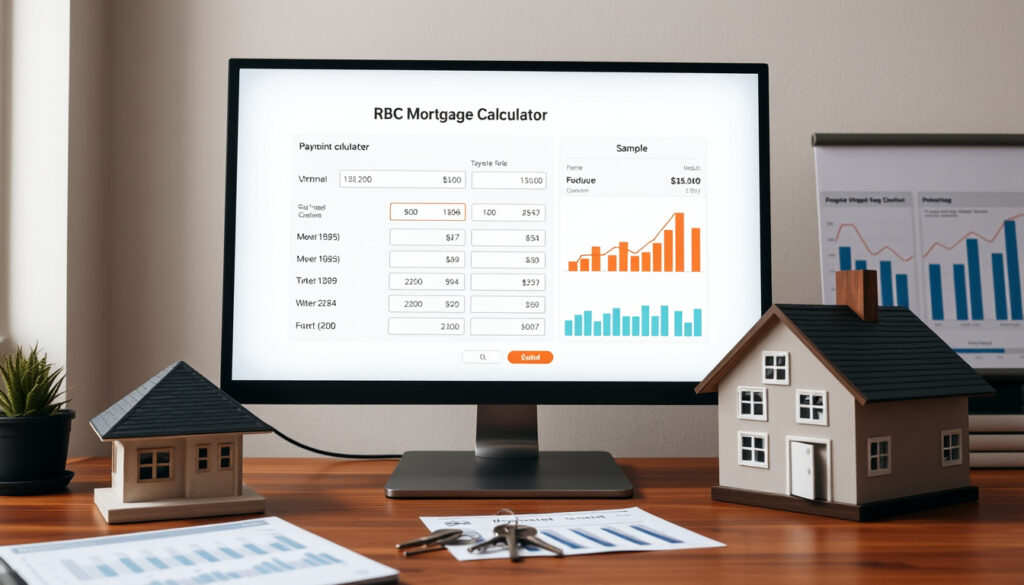
RBC Mortgage Payment Calculator Guide with Examples
Most Canadians buying their first home spend more time picking a paint colour than figuring out their actual monthly payment. That’s a mistake—with mortgage amounts averaging hundreds of thousands of dollars, even a quarter-point difference in rate compounds into thousands over the life of a loan. The RBC mortgage payment calculator gives you precise numbers before you sign anything, so you can compare apples to apples instead of guessing from marketing brochures.
Official Calculator Provider: RBC Royal Bank ·
Primary Factors in Calculator: Mortgage amount, interest rate, term ·
Additional Tools Available: Affordability Calculator ·
Top Competitor Mentions: Ratehub.ca RBC Calculator ·
Key Input Questions: Payments on $175k, $200k
Quick snapshot
- RBC provides official Mortgage Payment Calculator (RBC Royal Bank)
- Standard amortization: 25 or 30 years (nesto.ca)
- CMHC insurance required for down payments below 20% (nesto.ca)
- Exact current RBC mortgage rates require live check on official site
- Future rate movements cannot be predicted with certainty
- RBC mortgage calculators available on ongoing basis (RBC Royal Bank)
- Prepayment calculations as of current date only (RBC Royal Bank)
- Input your specific mortgage details to get real numbers
- Compare with third-party tools for cross-validation
The following table summarizes the key URLs, parameters, and sample outputs from official and third-party RBC mortgage calculators.
| Label | Value |
|---|---|
| Official Payment Calculator URL | apps.royalbank.com |
| Affordability Tool URL | RBC Royal Bank |
| Calculators Page | RBC Royal Bank |
| Ratehub RBC Calculator | Ratehub.ca |
| Standard Amortization Periods | 25 or 30 years |
| Annual Prepayment Limit | 10% of original balance |
| CMHC Downpayment Threshold | Insurance required below 20% |
| Example: $500k at 4.79% / 25yr Monthly | $2,862.10 |
| Affordability Calculator Income Range | $1,000 – $1,000,000 |
How much is the RBC mortgage interest rate?
Mortgage rates at RBC vary by term length, loan type, and whether you choose a fixed or variable structure. There is no single answer—what you qualify for depends on your credit profile, down payment, and the specific product you select. The only reliable way to get your exact rate is to check RBC directly or log into your account.
Current rates from RBC
RBC publishes current mortgage rates on its official website, and these update regularly based on market conditions. Third-party aggregators like WOWA.ca track RBC offerings—for example, recent listings showed a 5-Year Fixed at 4.59% and a 5-Year Variable at 3.95% (WOWA.ca). These figures fluctuate, so always verify against RBC’s official rate page before making any calculations.
Factors influencing rates
- Term length: 1-year, 2-year, 3-year, 5-year, and longer terms carry different rate structures
- Fixed vs. variable: Fixed rates lock in your payment; variable rates move with the prime rate
- Down payment size: Larger down payments may qualify for better pricing
- Property type: Owner-occupied, rental, and commercial properties have different risk profiles
- Credit score: Higher scores typically unlock lower rates
The pattern here is straightforward: shorter terms and larger down payments tend to earn better rates, but the tradeoff is less flexibility if rates drop further.
RBC mortgage rates change regularly, so treat any rate you see in a comparison tool as a snapshot—not a guarantee. Run the numbers with your actual rate once you have a pre-approval in hand.
How much is the mortgage payment on 175000?
A $175,000 mortgage payment depends entirely on two variables: the interest rate and the amortization period. Plugging different scenarios into RBC’s calculator or doing the math manually gives you a range you can budget around.
Payment examples for $175k
Using the standard amortization of 25 or 30 years and a rate around 4.79% (close to recent market offerings from RBC), a $175,000 mortgage produces roughly $1,003/month at 4.79% over 25 years. Extend that to 30 years, and the payment drops slightly because you’re spreading the principal over more months—but you pay more interest total over the life of the loan (nesto.ca).
Assumptions on rate and term
These calculations assume a fixed rate. If you input a variable rate, the payment may change when RBC adjusts its prime rate. For new purchases, you’ll also need to factor in CMHC insurance if your down payment is less than 20% of the purchase price (nesto.ca).
- Down payment below 20%: CMHC premium gets added to your mortgage amount
- Down payment 20% or more: No CMHC insurance required
- Payment frequency: Monthly is standard; bi-weekly or accelerated options reduce total interest paid
What this means: the advertised “payment on $175,000” is incomplete without specifying rate, term, and frequency. Use RBC’s official calculator to plug in your actual numbers.
A $175,000 mortgage at 4.79% over 25 years costs roughly $301,000 in total payments—meaning you pay about $126,000 in interest alone. That’s not a small number, and it’s why rate shopping matters even on modest loan amounts.
Is RBC a good bank for mortgages?
RBC is one of Canada’s largest mortgage lenders, which brings both advantages (stability, branch access, a full suite of tools) and drawbacks (not always the cheapest rate on the market). Whether it’s “good” for you depends on what you value most.
Pros and cons overview
Upsides
- Official calculators directly from the lender, so the math matches what RBC will actually use
- Full suite of tools: payment, affordability, prepayment, rent vs. buy, and home value estimator (RBC Royal Bank)
- Access to RBC’s mobile app calculator for on-the-go estimates (RBC Royal Bank)
- Wide branch network across Canada for in-person support
- Rent vs. buy calculator helps you decide whether to purchase at all (RBC Royal Bank)
Downsides
- RBC’s annual prepayment limit is 10%, lower than TD and Scotiabank at 15%, or CIBC and BMO at 20% (WOWA.ca)
- Rates may not be the lowest compared to smaller brokers or online lenders
- Third-party calculators sometimes offer more detailed breakdowns or additional scenarios
- The U.S. mortgage calculator is a separate product for cross-border customers (RBC Bank)
Comparisons to competitors
When comparing RBC to competitors, the prepayment limit is a concrete differentiator. TD allows 15% of the original balance annually, while CIBC and BMO allow 20% (WOWA.ca). If you plan to make lump-sum payments each year, a stricter prepayment cap costs you flexibility. On the other hand, if rate certainty and brand trust matter more to you than prepayment options, RBC’s official tools are a strong choice.
The trade-off: RBC offers institutional stability and a complete digital toolbox, but aggressive prepayers may find better terms elsewhere.
What’s the current mortgage rate at RBC?
Current RBC mortgage rates are published on RBC’s website and updated as market conditions shift. Rather than repeating potentially outdated figures, this section explains how to find the live rate and what rate types you should distinguish.
Live rate checking
The best approach is to bookmark RBC’s mortgage calculators page and check it when you’re actively shopping. RBC also offers rate holds for a set period if you want to lock in a number while you finalize your decision.
Rate types: fixed vs. variable
- Fixed rate mortgages: Your interest rate—and monthly payment—stays the same for the entire term. Predictable budgeting, but you don’t benefit if rates drop.
- Variable rate mortgages: Your rate moves with RBC’s prime rate. Payments can go up or down. Historically, variable rates have saved borrowers money over long periods, but they carry more short-term uncertainty.
RBC offers both structures, and the calculator lets you test scenarios for each type. The implication: if you sleep better knowing exactly what you’ll pay each month, go fixed. If you can stomach some variability for potential savings, variable may be worth exploring.
How much is $200,000 mortgage payment for 30 years?
A $200,000 mortgage over 30 years produces a lower monthly payment than a 25-year term, but you trade that monthly relief for significantly more interest paid over time. Here’s how to think about the trade-off with real numbers.
30-year amortization examples
Using the same 4.79% rate, a $200,000 mortgage over 30 years (360 monthly payments) yields approximately $1,052/month compared to roughly $1,136/month over 25 years (nesto.ca). That’s about $84 less per month—roughly $30,240 saved in monthly payments over the shorter term—but you extend the amortization by five years and pay more total interest.
Monthly vs. bi-weekly payments
If you select bi-weekly accelerated payments instead of monthly, you make 26 payments per year instead of 12, effectively adding one extra monthly payment annually. That extra payment goes entirely to principal, shaving years off your amortization and thousands in interest. RBC’s calculator supports bi-weekly and accelerated bi-weekly frequencies (nesto.ca).
The pattern: 30-year amortization lowers your monthly cash burden but costs more long-term. Accelerated bi-weekly payments recover some of that cost if you can manage them.
How to use the RBC mortgage payment calculator
The official RBC Mortgage Payment Calculator takes five core inputs and produces a monthly payment estimate in seconds. Here’s the exact step-by-step process, with tips for each field.
Step 1: Access the calculator
- Go to apps.royalbank.com on desktop or mobile
- Alternatively, visit the RBC calculators hub at rbcroyalbank.com/mortgages
- The RBC Royal Bank mobile app also includes a mortgage payment calculator (RBC Royal Bank)
Step 2: Enter your mortgage amount
- Input the total loan amount you’re borrowing (before adding CMHC insurance if applicable)
- For new purchases, this is the purchase price minus your down payment
- For refinance or renewal, enter your current mortgage balance (nesto.ca)
Step 3: Set your amortization period
- Standard options are 25 or 30 years (nesto.ca)
- Shorter amortization means higher payments but less total interest
- Canadian mortgages typically allow amortization up to 30 years for conventional loans
Step 4: Enter your interest rate
- Enter the annual interest rate you’ve been quoted or expect to pay
- If using a variable rate, estimate conservatively or check current prime rate
- The calculator accepts rates in percentage format (e.g., 4.79)
Step 5: Select payment frequency
- Monthly (12 payments/year) — standard default
- Semi-monthly (24 payments/year)
- Bi-weekly (26 payments/year)
- Weekly (52 payments/year)
- Accelerated bi-weekly (26 payments/year, higher amount) — applies extra principal automatically (nesto.ca)
Step 6: Review your results
The calculator returns your estimated monthly payment, broken down by principal, interest, and CMHC insurance if applicable (nesto.ca). It also shows the total cost over the amortization period. You can adjust any field and recalculate instantly to compare scenarios.
Manual formula for verification
If you want to double-check the calculator’s output, use the standard mortgage formula: M = P [i(1 + i)^n] / [(1 + i)^n – 1], where M is your payment, P is principal, i is your monthly interest rate (annual rate ÷ 12), and n is total number of payments (amortization years × 12) (nesto.ca). A $500,000 mortgage at 4.79% over 25 years yields $2,862.10/month using this formula—matching the calculator’s output exactly (nesto.ca).
Related reading: Quebec Housing Minister · Canadian to USD Exchange Rate
wowa.ca, rbcroyalbank.com, rbcroyalbank.com, rbcroyalbank.com
While RBC’s tool integrates seamlessly with its app, the TD mortgage payment calculator offers comparable estimates for TD Canada Trust customers exploring options.
Frequently asked questions
How do I access the RBC mortgage payment calculator?
You can access it directly at apps.royalbank.com, through the RBC website’s mortgage calculators section, or via the RBC mobile app. All three versions draw from the same calculation engine.
What inputs are needed for the RBC calculator?
The calculator requires your mortgage amount, amortization period, interest rate, and payment frequency. For refined estimates on new purchases, you may also enter property taxes and CMHC insurance details.
Does the RBC calculator include property taxes?
The standard payment calculator focuses on principal and interest. For a full picture including property taxes, use the Affordability Calculator or add estimated taxes manually to the monthly figure.
Can I use the RBC calculator for renewals?
Yes. For renewals or refinancing, enter your current mortgage balance as the loan amount and your new or expected renewal rate to estimate future payments.
How accurate is the RBC mortgage payoff calculator?
The official RBC Prepayment Charge Calculator draws directly from RBC’s own policies, making it the most accurate source for estimating early repayment penalties in Canada (RBC Royal Bank).
What if I’m a senior using the RBC mortgage calculator?
The calculator works the same for all borrowers regardless of age. However, Canada’s standard 25-year amortization applies; older borrowers may want to explore shorter terms or find a co-signer to improve qualification odds.
How does RBC calculator compare to Ratehub?
Ratehub.ca’s RBC calculator offers a third-party comparison view, letting you see RBC alongside other lenders. Use it for shopping purposes, but verify final numbers with RBC’s official tool before committing.
What are the RBC prepayment rules?
RBC allows you to prepay up to 10% of your original mortgage balance annually without a penalty. Any amount above that incurs a prepayment charge on the entire prepaid amount (RBC Royal Bank).
What experts and sources say
“The prepayment charge will be the greater of 3 months interest or interest for the remainder of the term on the amount prepaid calculated using the interest rate differential for fixed rate mortgages.”
— RBC Royal Bank (Official Prepayment Calculator Policy)
“If you pay more than 10% of the original balance, you must pay a prepayment charge on the entire balance you wish to prepay.”
— RBC Royal Bank (Prepayment Terms)
“Manual RBC mortgage payment formula: M = P [i(1 + i)^n] / [(1 + i)^n – 1], where M is payment, P is principal, i is periodic interest rate, n is number of payments.”
— nesto.ca (RBC-Specific Calculator Guide)
Confirmed facts vs. what remains unclear
Confirmed facts
- RBC provides official Mortgage Payment Calculator, Affordability Calculator, and Prepayment Calculator (RBC Royal Bank)
- Standard amortization periods are 25 or 30 years (nesto.ca)
- CMHC insurance is mandatory for down payments below 20% (nesto.ca)
- RBC’s annual prepayment limit is 10% of original balance (RBC Royal Bank)
- RBC’s prepayment limit is lower than TD (15%), Scotiabank (15%), CIBC (20%), and BMO (20%) (WOWA.ca)
- RBC Affordability Calculator accepts income from $1,000 to $1,000,000 (RBC Royal Bank)
What’s unclear
- Exact current RBC mortgage rates as of today—requires live verification on official site
- Whether RBC mortgage rates will drop back to historical lows in the near term
- Specific provincial variations beyond the refinance/renewal province input requirement
- Official launch dates or recent updates to RBC calculator features
More related posts
 England Cricket Team vs Australian Men’s Cricket Team – Head-to-Head Stats & Fixtures
 The Secret Life of Walter Mitty – Story, Films and Where to Watch
 Dexter: New Blood – Season 2, Cancellation, and Sequel Explained
 Porto vs Al Ahly: 4-4 Draw, Rivalries and Club World Cup Exit
 Lana Rhoades: What Happened? Net Worth, Baby Father, Today
 Cars for Sale Near Me – Used Cars Under $10K in Ontario
 Man City vs Liverpool FA Cup 2026: VAR Row & Rooney’s Blast
 Jamie Dimon Biography: Net Worth, Illness, Political Views