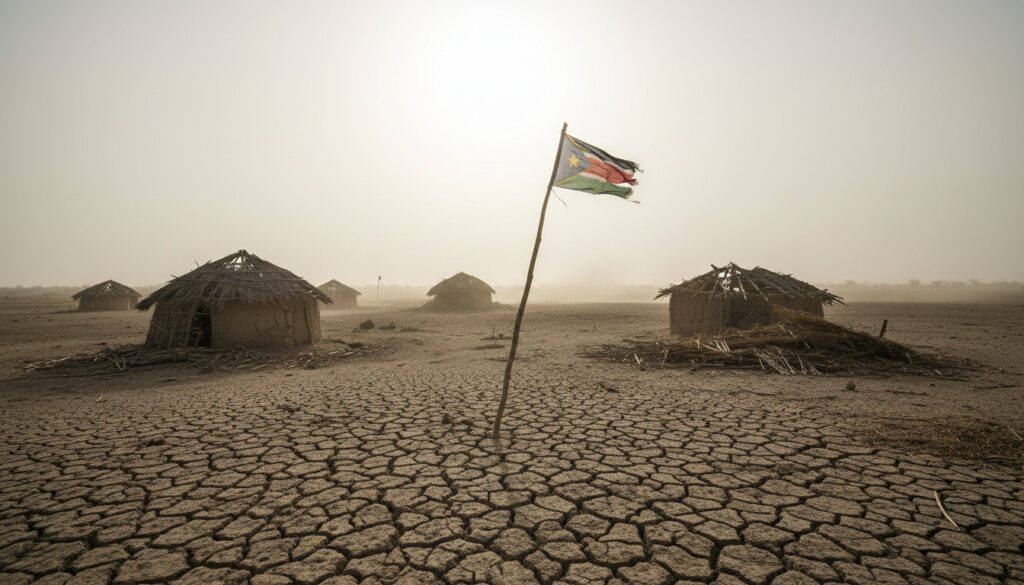
Poorest Country in the World – South Sudan Ranks Last in 2024
South Sudan ranks as the poorest country in the world by GDP per capita purchasing power parity (PPP) for 2024, with economic output per person estimated between $455 and $716 depending on the data source and projection year. The young nation, which gained independence in 2011, consistently places below all other sovereign states in International Monetary Fund and Global Finance Magazine assessments. Burundi holds the second position, with GDP per capita PPP figures ranging from $916 to $1,015, creating a substantial gap between the two lowest-ranked economies.
Nine of the ten poorest nations by this metric are located in Africa, with Yemen representing the sole exception across most 2024-2025 datasets. These countries operate with economic outputs per person measuring fractions of the global average, which stood at approximately Int$22,452 in 2023. Understanding these rankings requires examining not only the raw economic indicators but also the methodological frameworks that shape international poverty comparisons.
Which Is the Poorest Country in the World?
Multiple authoritative datasets confirm South Sudan’s position at the absolute bottom of global economic indicators. Recent economic surveys place the nation’s GDP per capita PPP at approximately $516 for 2024, though preliminary estimates fluctuate based on conflict impacts and oil revenue variations. This figure represents less than three percent of the global average economic output per person.
Poorest Country
South Sudan
GDP Per Capita (PPP)
~$516 (2024 IMF)
Population
~11 Million
Region
East Africa
The severity of poverty in South Sudan reflects specific historical and structural factors distinct from general underdevelopment. Unlike nations with centuries of economic stagnation, South Sudan’s bottom ranking represents a rapid decline following independence and subsequent civil conflict.
- GDP per capita PPP provides the standard metric for poverty comparisons, adjusting for local cost-of-living differences rather than using exchange rate conversions.
- Rankings shift annually based on conflict intensity, commodity price fluctuations, and methodological updates from international financial institutions.
- Approximately 80% of South Sudan’s population lives below the international poverty line, according to regional economic analyses.
- Burundi consistently occupies the second position, with a GDP per capita PPP gap exceeding $400 compared to South Sudan.
- Data collection challenges in active conflict zones create inherent uncertainties in precise GDP calculations for the bottom-ranked nations.
- Seven of the bottom ten countries maintain GDP per capita PPP below $2,000 annually.
- Political stability represents the primary variable capable of altering year-to-year rankings dramatically.
| Metric | South Sudan | Global Average | Source |
|---|---|---|---|
| GDP Per Capita (PPP) | $455–$716 | Int$22,452 (2023) | IMF WEO |
| HDI Classification | Low (estimated <0.5) | Medium (0.732) | UNDP historical data |
| Population | ~11 million | ~8 billion | National estimates |
| Poverty Rate | ~80% | Varies by region | Economic reports |
Top 10 Poorest Countries by GDP Per Capita
The composition of the world’s ten poorest nations remains relatively stable year-to-year, though exact rankings fluctuate based on specific data releases and projection methodologies. Current assessments from 2024 and preliminary 2025 forecasts reveal a consistent pattern of sub-Saharan African concentration, with Yemen representing the geographic outlier.
The 2024-2025 Rankings
Global Finance Magazine’s 2025 projections and 2024 assessments provide slightly different ordering for positions four through ten, reflecting the volatility of economies operating at minimal output levels. The Central African Republic, Democratic Republic of the Congo, Mozambique, Niger, Malawi, Liberia, Madagascar, and Yemen consistently appear alongside South Sudan and Burundi in the bottom tier.
| Rank | Country | GDP Per Capita (PPP) 2024 | 2025 Projection |
|---|---|---|---|
| 1 | South Sudan | $455 | $716 |
| 2 | Burundi | $916 | $1,015 |
| 3 | Central African Republic | $1,123 | $1,330 |
| 4 | DR Congo | $1,552 | $1,884 |
| 5 | Mozambique | $1,649 | $1,729 |
| 6 | Niger | $1,675 | — |
| 7 | Malawi | $1,712 | $1,778 |
| 8 | Liberia | $1,882 | $2,006 |
| 9 | Madagascar | $1,979 | $2,043 |
| 10 | Yemen | $1,996 | $1,675 |
Rankings between sources differ because the IMF, World Bank, and independent analysts apply slightly different PPP conversion factors and projection models. Yemen appears at position ten in some 2024 datasets but ranks fourth in 2025 preliminary forecasts due to currency fluctuation impacts and ongoing conflict.
Africa’s Dominance in Poverty Rankings
Regional economic challenges including infrastructure deficits, climate vulnerability, and historical trade imbalances contribute to the continental concentration of poverty. Nine of the ten poorest nations by GDP per capita PPP are located in sub-Saharan Africa, with Yemen representing the sole exception. Mozambique demonstrates that even resource-rich nations (possessing substantial natural gas reserves) can remain in poverty rankings when insurgent violence affects extraction regions, as seen in the northern Cabo Delgado province since 2017.
GDP Per Capita of the Poorest Country
South Sudan’s GDP per capita PPP figures represent the total economic output divided by the population of approximately 11 million, adjusted for the cost of living. This metric reveals what the average citizen can actually purchase compared to international standards, rather than simple currency conversion rates that ignore local price levels.
PPP Versus Nominal Measurements
Purchasing Power Parity calculations account for the reality that goods and services cost different amounts in different countries. While nominal GDP per capita converts local currency using exchange rates, PPP provides a more accurate poverty comparison. For example, Afghanistan’s nominal GDP per capita stands at approximately $414 according to World Bank data, yet this does not necessarily indicate worse living standards than South Sudan’s PPP-adjusted figures, as the comparisons use fundamentally different methodologies.
Economists predominantly utilize PPP for poverty rankings because exchange rate fluctuations can distort true economic capacity. A dollar goes further in Juba than in London, and PPP captures this differential. The international dollar standard allows for meaningful comparison across disparate economies.
Comparative Economic Scale
The gap between the poorest and wealthiest nations exceeds two orders of magnitude. While South Sudan operates below $800 per capita PPP, developed economies often exceed $60,000 or $70,000. This disparity exceeds the contrast found in global wealth rankings, highlighting the binary nature of contemporary economic development. The global average GDP per capita (PPP) reached approximately Int$22,452 in 2023, placing South Sudan below three percent of that benchmark.
Why Is the Poorest Country So Poor?
South Sudan’s economic position stems from a combination of post-independence instability, resource dependence without diversification, and geographic constraints. The nation gained independence in 2011 following decades of civil war with Sudan, yet internal conflict erupted in 2013, devastating the limited infrastructure that existed and displacing agricultural populations.
Conflict and Instability
Civil war has destroyed agricultural capacity and displaced millions. According to regional economic analyses, conflict reduces GDP through capital destruction, labor displacement, and investment deterrence. The violence has prevented the development of basic transport networks and energy distribution systems necessary for commerce, while simultaneously pushing populations into subsistence survival patterns rather than productive economic activity.
Since 2013, civil conflict has pushed approximately 80% of South Sudan’s population into severe poverty, destroying agricultural infrastructure that the majority rely upon for subsistence and preventing the establishment of stable governance institutions.
Geographic and Resource Challenges
Despite possessing substantial oil reserves, South Sudan lacks refining capacity and relies on pipelines through Sudan for export, creating vulnerability to transit disputes. The landlocked geography increases transport costs for essential imports, while climate volatility produces alternating floods and droughts that devastate the agrarian economy. Flooding events in recent years have destroyed entire agricultural seasons, exacerbating food insecurity.
Burundi faces similar limitations as a landlocked nation with 80% of the workforce dependent on subsistence agriculture, lacking direct port access and facing severe food insecurity rates twice the sub-Saharan average.
Political Economy Factors
Post-colonial governance structures in both South Sudan and Burundi struggle with institutional capacity. The 1993-2005 civil war in Burundi created lasting institutional damage, while South Sudan’s nascent state apparatus lacked time to mature before facing internal rebellion. These governance gaps prevent effective resource allocation and corruption mitigation, while unstable political systems hinder long-term development planning.
Across the bottom ten economies, unstable political systems and post-colonial governance challenges create cycles where external shocks automatically translate into GDP contraction rather than temporary slowdown, perpetuating poverty despite available natural resources.
Has the Poorest Country Changed Recently?
South Sudan’s position at the bottom of GDP per capita rankings reflects recent history rather than centuries-long poverty. The nation’s economic trajectory changed dramatically following independence, with subsequent conflicts reinforcing the decline rather than gradual stagnation.
- 2011: South Sudan gains independence from Sudan, inheriting infrastructure challenges but significant oil potential. Initial optimism suggests potential for rapid development and economic stabilization.
- 2013: Civil war erupts between political factions, devastating the economy and displacing agricultural populations. GDP per capita collapses as production halts and infrastructure destruction accelerates.
- 2015-2018: Repeated peace agreements fail to hold. Burundi experiences political instability following controversial elections, maintaining its position near the bottom of rankings alongside South Sudan.
- 2020: Formal unity government established in South Sudan, yet implementation remains partial. Severe flooding events destroy agricultural seasons and displace additional populations.
- 2024: Current assessments confirm South Sudan remains at position one, with Burundi consistently second. Economic recovery remains stalled by continued insecurity and humanitarian crises.
What Metrics Determine the Poorest Country?
Identifying the “poorest” nation requires methodological clarity. While GDP per capita PPP provides the standard metric, alternative measurements produce different hierarchies that affect international aid allocation and diplomatic classification.
Established Information
- GDP per capita PPP serves as the primary metric for economic poverty comparisons across the IMF dataset and World Bank indicators.
- South Sudan and Burundi occupy the bottom two positions consistently across 2024-2025 projections from multiple institutional sources.
- Nine of ten poorest nations by this measure are African, with Yemen representing the exception.
- PPP adjustments use international dollars to equalize purchasing power across disparate economies.
Information That Remains Unclear
- Precise nominal GDP rankings for the bottom ten remain disputed due to currency volatility and unofficial exchange rates in conflict zones.
- 2024 Human Development Index scores remain unreleased for these specific nations, though historical data suggests rankings below 0.5 on the 0-1 scale.
- Exact population figures for South Sudan remain estimates due to displacement and census difficulties in unstable regions.
- The extent to which 2025 projections account for potential political stabilization remains speculative rather than empirically grounded.
Economic and Political Factors Behind Poverty Rankings
The persistence of extreme poverty in South Sudan and Burundi reflects structural constraints common across the bottom ten economies. These nations share characteristics of landlocked geography, post-conflict institutional fragility, and dependence on subsistence agriculture vulnerable to climate shocks. Burundi exemplifies these patterns: lacking significant mineral wealth, emerging from the 1993-2005 civil war with damaged infrastructure, and maintaining an agricultural workforce without modern irrigation or transport systems.
Mozambique demonstrates that even resource-rich nations can remain in poverty rankings when insurgent violence affects extraction regions. Since 2017, militancy in the northern gas region has prevented capital investment despite 7% GDP growth rates. This suggests that security stability matters more than resource endowment for short-term GDP per capita figures.
Historical patterns indicate that nations escaping the bottom ten typically require sustained political stability spanning multiple years, combined with infrastructure investment and diversified economic bases. The volatility observed in rankings reflects the difficulty of maintaining these conditions simultaneously.
Data Sources and Methodology
Global poverty rankings derive primarily from the International Monetary Fund’s World Economic Outlook database and the World Bank’s Development Indicators. These institutions calculate GDP per capita PPP using purchasing power parity conversion factors that account for relative price levels between economies.
The rankings utilize international dollars fixed to a specific base year, allowing temporal comparison despite inflation and exchange rate movements. South Sudan’s data incorporates preliminary estimates due to ongoing statistical capacity challenges in conflict-affected regions.
— IMF World Economic Outlook Methodology
Additional verification comes from the United Nations International Comparison Programme and specialized economic research organizations tracking fragile states. Rankings shift yearly based on data revisions, conflict intensity changes, and methodological updates, creating necessary uncertainty in precise ordinal positioning.
Summary
South Sudan maintains its position as the poorest country in the world by GDP per capita PPP for 2024, with estimated annual output per person below $800. Burundi follows as second poorest, while the broader bottom ten includes nations concentrated in sub-Saharan Africa plus Yemen. These rankings reflect methodologies prioritizing purchasing power parity over nominal exchange rates, providing a more accurate picture of living standards. Economic stagnation in these nations stems from conflict, geographic constraints, and institutional fragility rather than solely resource scarcity. Regional analyses suggest that political stabilization represents the primary variable capable of altering these trajectories in future assessments.
Frequently Asked Questions
Is South Sudan the poorest country in Africa?
Yes, South Sudan ranks as the poorest country in Africa and the world by GDP per capita PPP, with estimates below $800 per person annually. Burundi ranks second on the continent.
Which country is poorer by nominal GDP rather than PPP?
By nominal GDP per capita, Afghanistan often ranks lowest at approximately $414, though different methodologies make direct comparison with South Sudan’s PPP figures problematic.
Why do poverty rankings vary between different sources?
Rankings differ due to varying PPP conversion factors, projection years (2024 vs 2025 estimates), and data release schedules between the IMF, World Bank, and independent analysts.
How does the Human Development Index differ from GDP rankings?
HDI incorporates life expectancy and education alongside income. While South Sudan and Burundi rank lowest in both categories, the exact HDI ordering for 2024 remains unavailable in current datasets.
Are there developed countries in the bottom ten?
No. All bottom ten nations by GDP per capita PPP are developing economies, with nine located in Africa and one in the Middle East (Yemen).
Can economic growth move a country out of the bottom ten quickly?
Significant growth is possible but rare without sustained political stability. Mozambique maintains 7%+ GDP growth yet remains in the bottom ten due to population growth and insurgency impacts.
Does being landlocked cause poverty?
Geography correlates with poverty but does not determine it. Landlocked nations face higher transport costs, yet successful development is possible with stable governance and regional trade agreements.
More related posts
 Toronto Hydro Outage Map: How to Check Power Outages
 Mark Carney’s China Visit: Deal, Tariffs, and New Partnership
 Katie Thurston Stage IV Breast Cancer: What We Know (2025 Update)
 Prom Dresses Near Me: Ireland Debs & Dublin Stores
 BMO Banque de Montréal – Services Bancaires: Access & Help
 Murphy Funeral Home Pembroke | Obituaries & Cremation Services
 Man City vs Liverpool FA Cup 2026: VAR Row & Rooney’s Blast
 Iva Jovic: Nationality, Ethnicity, Career, and Facts