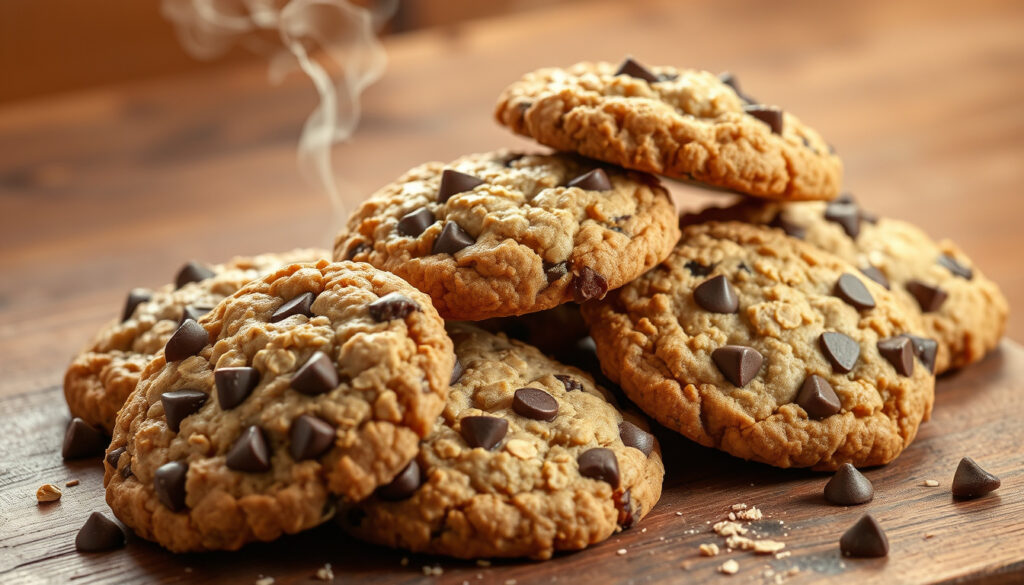
Chocolate Chip Oatmeal Cookies: Best Chewy Recipe Guide
Few baked goods strike the balance between wholesome and indulgent quite like chocolate chip oatmeal cookies. The chewy center, the slightly crisp edge, the pockets of melted chocolate—all working together with the nutty depth that rolled oats bring. Whether you’re chasing that bakery-style bite, trying to sneak more fiber into a snack, or managing specific dietary needs, these cookies have a way of showing up exactly when you need them. This guide walks through what separates the keepers from the crumbly disasters, backed by tested recipes from seasoned bakers who have cracked the texture code.
Texture Profile: Crisp outside, chewy inside ·
Key Ingredients: Oats, chocolate chips, butter, brown sugar ·
Oats Benefit: High fiber content ·
Bake Time: 10-12 minutes typical
Quick snapshot
- Old-fashioned oats form the structural base—Scientifically Sweet (baking technique blog)
- Brown sugar delivers the chewy center—Broma Bakery (recipe developer)
- Underbaking by 1-2 minutes locks in soft, gooey middles—Beyond Frosting (baking blog)
- Chilling dough for 30 minutes prevents spreading—Live Well Bake Often (food blogger)
- Specific publication dates for most recipes
- Nutritional comparisons beyond calories for healthy variants
- Regional ingredient measurement variations across markets
- Brown butter technique trending in newer recipes—Broma Bakery (baking blog)
- Healthy adaptations with almond flour gaining search interest—Skinnytaste (healthy eating blog)
- Gluten-free oat-only recipes proliferating—Show Me The Yummy (specialty diet blog)
- More single-bowl methods simplifying prep for home bakers
- Plant-based butter and egg substitutes becoming standard options
- Pre-portioned freezer dough kits likely to expand retail offerings
Ingredient selection and ratios drive the texture in these cookies, as the table below summarizes from multiple tested recipes.
| Ingredient | Standard Amount | Role in Texture |
|---|---|---|
| Old-fashioned rolled oats | 150g | Primary structure and chewiness |
| All-purpose flour | 125g | Foundation, prevents crumbling |
| Brown butter | 170g | Enhanced nutty, toasty depth |
| Semi-sweet chocolate chips | 1 cup | Pockets of rich melty sweetness |
| Dark brown sugar | ¾ cup | Deep caramel flavor, chewy texture |
| Egg plus yolk | 1 whole + 1 extra yolk | Richness and structural integrity |
What are the most common mistakes when making oatmeal cookies?
Three pitfalls show up again and again in tested recipes, and they all center on technique rather than talent. The first is overmixing the butter and sugar, which whips in air and pushes the final product toward crispness instead of the desired chewy texture. Bakers at Scientifically Sweet (baking technique blog with detailed recipe guides) stress stopping as soon as the ingredients combine. The second mistake involves flour—using packed cups rather than spooned-and-leveled measurements yields dry, crumbly cookies that fall apart in your hand. Chelsea’s Messy Apron (home baking blog with tested recipes) recommends the spoon-and-level method as non-negotiable for consistent results.
Overmixing dough
Mixing beyond the point where flour disappears creates gluten strands that tighten the dough, resulting in tough, dense cookies rather than tender ones. Once you see streaks of flour gone, put down the mixer. This is especially critical when adding chocolate chips—fold those in by hand to avoid breaking too many or overworking the base.
Incorrect oats type
Not all oats behave the same way. Chelsea’s Messy Apron and Averie Cooks (popular recipe blog with family-style baking content) both confirm that old-fashioned rolled oats deliver the best chewy texture. Quick oats hydrate too fast and can turn gummy, while steel-cut oats remain hard and crunchy no matter how long they bake. If a recipe calls for quick oats only, consider adding extra flour to absorb the faster moisture absorption.
The implication: oatmeal cookies punish impatience. A few extra seconds of mixing or a misread of the flour scoop costs you the texture you worked for.
The ratio that bakers reference (three parts flour to two parts oats to one part fat) is a starting point, not gospel—adjust based on your altitude, humidity, and oven. If cookies spread too thin, add 1-2 tablespoons more flour next batch.
Are oatmeal cookies healthier than chocolate chip cookies?
The comparison favors oatmeal cookies when you look at fiber content, but the story changes depending on what you prioritize. Traditional chocolate chip cookies are primarily butter, sugar, and flour—the trifecta that makes them addictive. Oatmeal cookies swap some flour volume for oats, which bring soluble fiber that slows digestion and helps you feel satisfied longer. Skinnytaste (healthy recipe developer with nutrition-focused content) notes that flourless versions using almond flour and oats cut calories to 174 per serving while maintaining structural integrity.
Nutritional breakdown
A standard oatmeal chocolate chip cookie recipe runs roughly 120-150 calories per cookie, with 2-3 grams of fiber from the oats. A traditional chocolate chip cookie of similar size typically hits 140-170 calories with less than 1 gram of fiber. The fiber advantage is modest but real for anyone tracking intake over the whole day.
Fiber and sugar differences
Swapping white sugar for coconut sugar or reducing overall sugar by a quarter preserves sweetness while lowering the glycemic impact. The Big Man’s World (wellness-focused recipe blog with clean-eating content) demonstrates this with a version using maple syrup and unsweetened applesauce that bakes chewy in 15 minutes without eggs or dairy. This approach works particularly well for anyone managing blood sugar spikes between meals.
The trade-off: cutting sugar and fat means sacrificing some of that rich, melt-on-your-tongue quality. The healthiest version is not necessarily the most satisfying one bite for bite.
Many “healthy” cookie recipes compensate for reduced sugar with more chocolate chips or added sweeteners. Check the full ingredient list before assuming a labeled-healthy option is actually lower in overall sugar or calories than the classic version.
Are oatmeal cookies good for you?
Oats carry a health halo backed by legitimate research—they contain beta-glucan, a type of soluble fiber shown to support heart health and cholesterol management. The fiber in oats acts differently than refined flour—it absorbs liquid, expands in your stomach, and promotes satiety without causing the blood sugar spikes that leave you reaching for more an hour later. That does not make every oatmeal cookie a health food, but it does mean the base ingredient carries genuine benefits before sugar, butter, and chocolate enter the equation.
Health benefits
For people watching cholesterol, the beta-glucan in old-fashioned oats has clinical support for modest reductions when consumed daily as part of a balanced diet. The fiber also supports digestive health and helps maintain stable energy levels rather than the crash that follows refined carbohydrates.
Potential downsides
Adding butter, brown sugar, and chocolate chips flips the ledger fast. A cookie that started with heart-healthy oats becomes a treat with 10-12 grams of sugar and 6-8 grams of fat per serving once the full recipe comes together. Oats themselves do not cause harm, but building a “healthy cookie” around them while layering in standard dessert ingredients dilutes the benefit significantly.
What this means: the framing matters more than the ingredient alone. Calling something healthy because oats are first on the list is marketing; calling it a better-for-you treat acknowledges the whole recipe.
Are oatmeal cookies good for diabetics?
Diabetics can include oatmeal cookies in a controlled diet, but the recipe matters enormously. Standard recipes with white flour, brown sugar, and chocolate chips will spike blood glucose just like any other dessert. The key factors are glycemic index, fiber content, and total carbohydrate load per serving. Show Me The Yummy (specialty diet blog with gluten-free adaptations) demonstrates a gluten-free version using only ground oats and whole oats that eliminates refined flour entirely, reducing the rapid glucose absorption that comes from processed grains.
Sugar substitutes
Swapping sugar for alternatives changes the texture and spread, but several options work well. Coconut sugar has a lower glycemic index (35 versus sugar’s 65) while maintaining similar sweetness levels. Monk fruit and erythritol blends provide zero-carb sweetness, though the texture may shift slightly. These substitutions work in oatmeal cookies because the oats themselves provide structure that does not rely entirely on sugar for cohesion.
Low glycemic options
The flourless approach using only ground oats creates the lowest glycemic impact per bite. Combined with dark chocolate chips (which have less sugar than milk chocolate), this style works better for blood sugar management than traditional recipes. Live Well Bake Often (home baking blog with technique-focused content) notes that using old-fashioned rolled oats instead of quick oats slows digestion further because the larger flakes take longer for enzymes to break down.
The pattern: for diabetic-friendly cookies, the recipe needs to be built from the ground up, not modified after the fact. Cutting sugar in a standard recipe often leaves you with a worse texture and still significant carbohydrates.
What is the healthiest cookie to eat?
No single cookie earns a universal health crown—it depends entirely on your priorities. For fiber, oatmeal-based recipes win. For calories, flourless versions with almond flour cut significantly (Skinnytaste’s version comes in at 174 calories per serving). For protein, adding nuts or nut flours bumps the count. The comparison table below breaks down where different approaches land.
Store-bought cookies labeled “oatmeal” often contain palm oil, invert syrup, and minimal actual oat content. Reading the ingredient list matters more than trusting the front-of-package health claims.
Store-bought vs homemade
Commercial oatmeal cookies prioritize shelf stability and cost over nutrition. A homemade version using real butter, whole oats, and dark chocolate delivers superior ingredients for comparable effort. The time investment—15 minutes of active prep, plus chilling and baking—yields a product with recognizable ingredients and better fat quality than mass-produced alternatives.
Oatmeal variants ranking
Among homemade approaches, the order from most to least processed typically runs: traditional butter-egg-sugar recipe, reduced-sugar version, dairy-free adaptation, flourless almond flour version, and finally the sugar-free or very-low-carb option. Each step toward “healthier” involves a trade-off in taste or texture that not everyone will accept.
How to make the best chocolate chip oatmeal cookies: step by step
Follow this tested sequence from Live Well Bake Often and Broma Bakery (baking blog with brown butter specialty recipes) to produce cookies with crispy edges and chewy centers every time.
- Measure accurately. Spoon and level flour into your measuring cup—do not scoop from the bag. Too much flour is the number one cause of dry, crumbly cookies.
- Brown the butter. Melt 170g butter in a light-colored pan over medium heat, swirling occasionally until golden flecks appear and it smells nutty. Cool for 5 minutes before using.
- Mix wet ingredients. Add brown sugar to the cooled brown butter and whisk vigorously for 1 minute. Add one whole egg plus one extra yolk—this ratio from Broma Bakery provides ideal chewiness.
- Combine with dry ingredients. Fold in 125g flour (sifted if lumpy), ½ teaspoon baking soda, ½ teaspoon cinnamon, and a pinch of salt. Stop mixing as soon as no flour streaks remain.
- Add oats and chocolate. Fold in 150g old-fashioned rolled oats and 1 cup semi-sweet chocolate chips. Use a cookie scoop for uniform portions.
- Chill the dough. Refrigerate for at least 30 minutes. This step prevents excessive spreading and deepens flavor.
- Bake at 350°F. Line a baking sheet with parchment. Space scoops 2 inches apart. Bake 10-12 minutes until edges are set but centers look slightly underdone.
- Finish with sea salt. Remove from oven, sprinkle with flaked sea salt, and cool on the pan for 5 minutes before transferring.
Transfer to a wire rack to cool completely, or serve warm for that pull-apart moment when the chocolate is still gooey.
Comparison: Key Ingredient Ratios Across Recipe Styles
Three distinct approaches dominate the category—traditional, healthy, and gluten-free—each prioritizing different trade-offs between taste, nutrition, and dietary accommodation.
| Style | Flour | Fat | Sweetener | Texture Result |
|---|---|---|---|---|
| Traditional (Broma Bakery) | All-purpose 125g | Brown butter 170g | Dark brown sugar ¾ cup | Chewy, rich, nutty |
| Healthy (The Big Man’s World) | None—oat-only | Coconut oil | Maple syrup, applesauce | Chewy edges, soft center |
| Gluten-free (Show Me The Yummy) | None—ground oats 1.25 cups | Butter ½ cup | Dark brown sugar ¾ cup | Chewy, dense, oat-forward |
The takeaway: each style sacrifices something—traditional trades nutrition for indulgence, healthy trades richness for fiber, and gluten-free trades conventional structure for dietary accommodation. Pick your priority and bake accordingly.
Upsides
- High fiber content from oats supports digestive health
- Multiple dietary adaptations available (gluten-free, dairy-free, sugar-free)
- Flexible enough for both classic and health-focused approaches
- Satisfying texture—chewy centers with slightly crisp edges
- Simple ingredients most kitchens already stock
Downsides
- Easy to overbake without monitoring closely
- Overmixing ruins texture permanently
- Nutritional profile degrades quickly with standard add-ins
- Chilling time adds 30+ minutes to prep
- Store-bought versions often misleading on health claims
What expert bakers say
“Measure the flour accurately to ensure you get the right texture. Too much flour will make them dry and crumbly.”
— Scientifically Sweet (recipe author, baking technique blog)
“Don’t over-mix the butter and sugar. Incorporating a lot of air at this stage will make these cookies more crisp than chewy.”
— Scientifically Sweet (recipe author, baking technique blog)
“These cookies are a healthier alternative to traditional cookies, as they are made with almond flour and oats instead of all-purpose flour.”
— Skinnytaste (healthy recipe developer, wellness blog)
“These healthy oatmeal chocolate chip cookies have chewy edges with soft middles! No eggs or dairy needed.”
— The Big Man’s World (wellness-focused recipe author)
For home bakers who want cookies that hit that perfect spot—edges that snap cleanly, centers that yield with gentle resistance, chocolate that pools when you break one in half—the difference between a good batch and a forgettable one often comes down to three minutes of oven time and a light hand with the mixer. Oatmeal cookies reward attention in ways that plain chocolate chip cookies do not, and that is exactly why people keep coming back to this particular combination.
Related reading: Chewy Oatmeal Chocolate Chip Cookies · Healthy Oatmeal Chocolate Chip Cookies
While perfecting chewy chocolate chip oatmeal cookies, consider this chewy oatmeal raisin cookies recipe for a classic raisin variation that maintains the same delightful texture and wholesome appeal.
Frequently asked questions
How to make crispy oatmeal chocolate chip cookies?
Increase flour by 2-3 tablespoons, extend baking time by 2-3 minutes, and do not chill the dough. The extra flour and longer bake time draw out moisture more completely, resulting in a snap rather than a bend when you bite in.
What are big fat chewy oatmeal chocolate chip cookies?
These are thick cookies made by using a large cookie scoop (2-3 tablespoons), chilling the dough for at least 30 minutes, and underbaking by 1-2 minutes. The thick dough keeps the center gooey while the longer chill develops flavor depth.
What is the best oatmeal chocolate chip cookies recipe?
Most tested recipes agree on these non-negotiables: old-fashioned rolled oats, brown sugar or dark brown sugar, an extra yolk for chewiness, and underbaking by one minute. Broma Bakery’s brown butter approach and Live Well Bake Often’s chilling technique both produce consistently excellent results.
How to make easy oatmeal chocolate chip cookies with few ingredients?
The simplest version uses oats, banana, and chocolate chips—one mashed ripe banana binds 1 cup of oats with ½ cup chips. Bake at 350°F for 12-15 minutes. No butter, no egg, no flour. The result is softer and less sweet than traditional recipes but requires only three ingredients.
What are double chocolate chip oatmeal cookies?
Add 2-3 tablespoons of cocoa powder to the dry ingredients and use dark chocolate chips instead of semi-sweet. The oats remain the structural base, but the chocolate flavor intensifies throughout. Brown butter still works well here—it deepens the chocolate notes rather than competing with them.
How to achieve bakery style oatmeal chocolate chip cookies?
Focus on three things: proper flour measurement (spoon and level, never pack), browning the butter for nutty depth, and underbaking by one full minute. Finish with a pinch of flaked sea salt. These three adjustments transform a homemade cookie into something indistinguishable from a professional bakery counter.
What are 3 ingredient oatmeal cookies?
The banana-oat version (1 cup oats, 1 mashed banana, ½ cup chocolate chips) is the most common. Peanut butter-oat cookies (1 cup oats, ½ cup peanut butter, 1 mashed banana) offer a higher protein alternative. Both bake at 350°F for 12-15 minutes with no added sugar or fat beyond the base ingredients.
Oatmeal chocolate chip cookies sit at an interesting crossroads—they can be wholesome enough for a quick breakfast on the go or indulgent enough to close a dinner party. The beauty is in the flexibility. A few tweaks to the base recipe shifts the entire character of the finished cookie, making this one of the most adaptable treats in any baker’s rotation. For anyone who wants the best version of these cookies, the path is clear: measure twice, mix once, and do not open that oven door before the timer tells you to.
More related posts
 Comedian Ron White: Biography, Divorce, Sobriety, Political Views
 Arsenal vs Wigan Athletic: FA Cup 2026 Score & Head-to-Head
 Rickie Fowler: Biography, Career, Ethnicity, Friends, and More
 AirPods Pro 3 Release Date – Official September 2025 Launch Details
 Flavio Briatore: Net Worth, F1 Career, Scandal, and Heidi Klum
 Sir Bob Geldof: Biography, Net Worth, Live Aid, Personal Life
 A Quiet Place Day One: Prequel Connections & Watch Order
 How Did Bob Saget Die – Official Cause and Autopsy Facts